
Performance
Titanium targets low-overhead reverse proxying and HTTPS interception: connection pooling, HTTP/2 multiplexing, and buffer reuse.
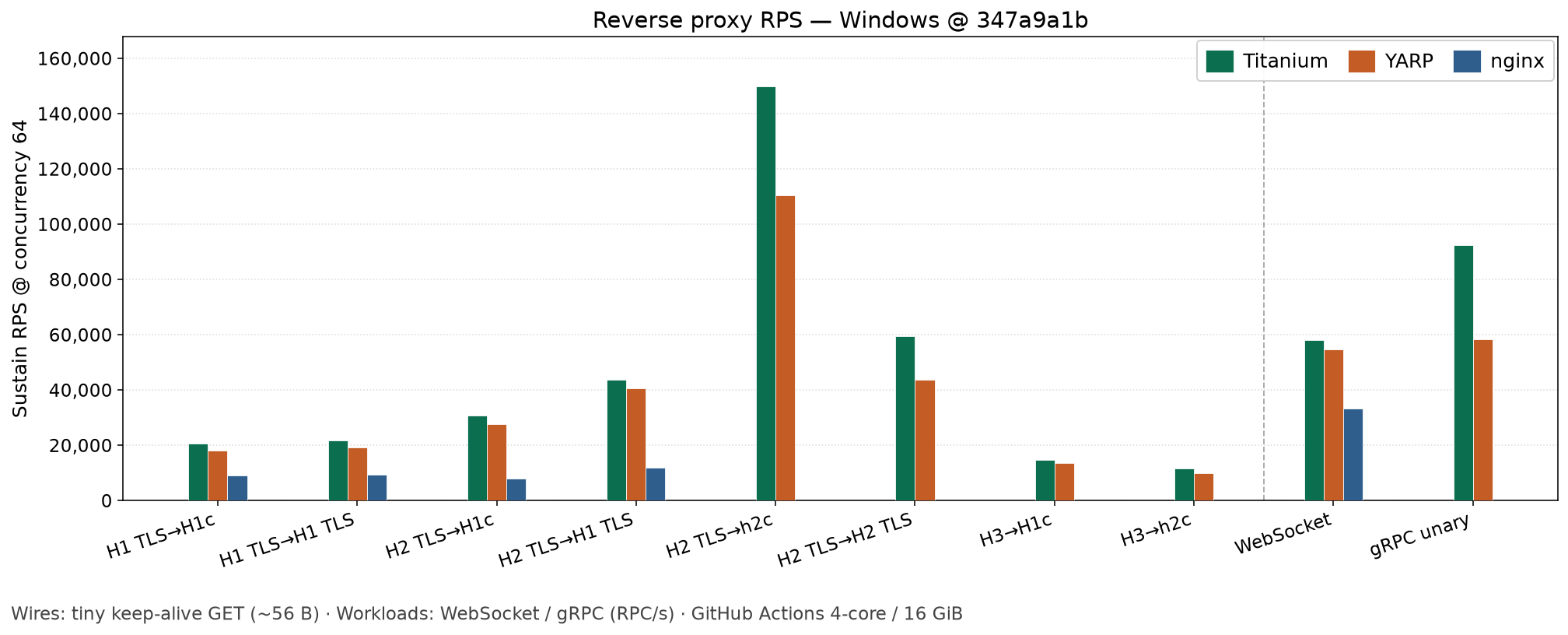
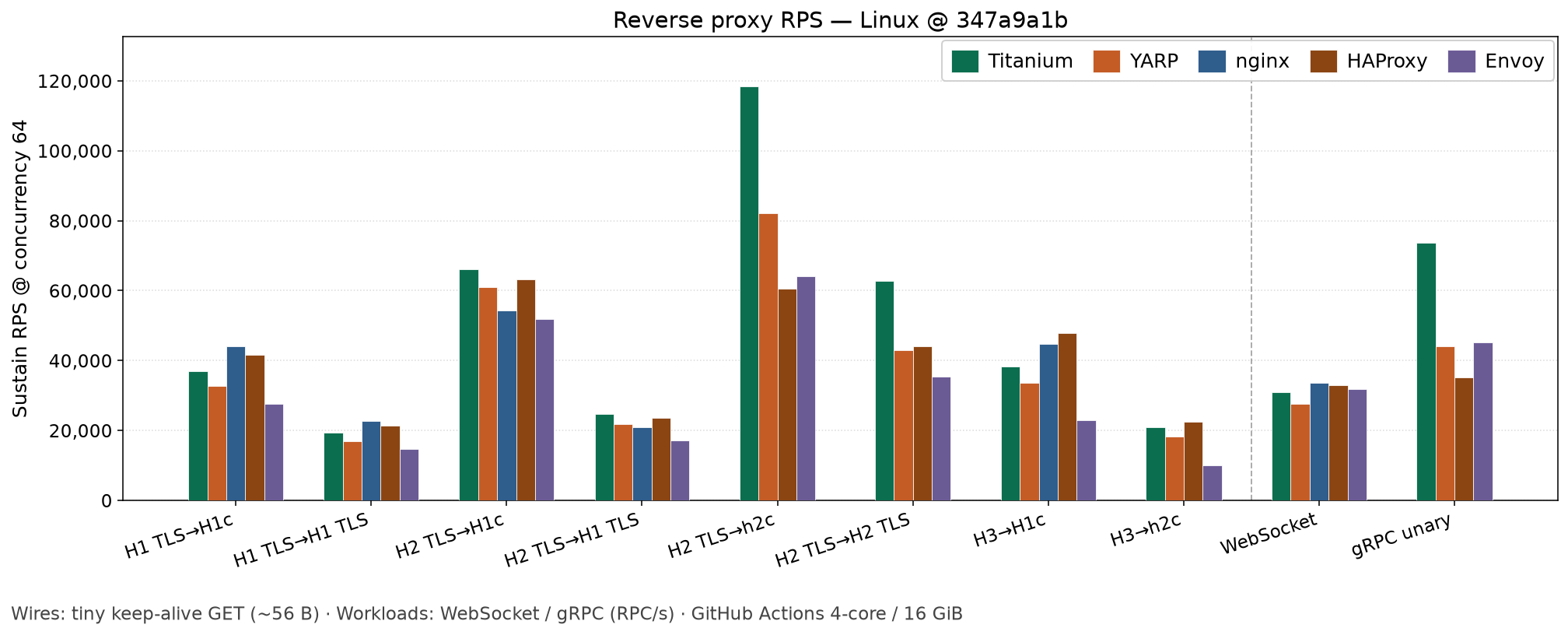
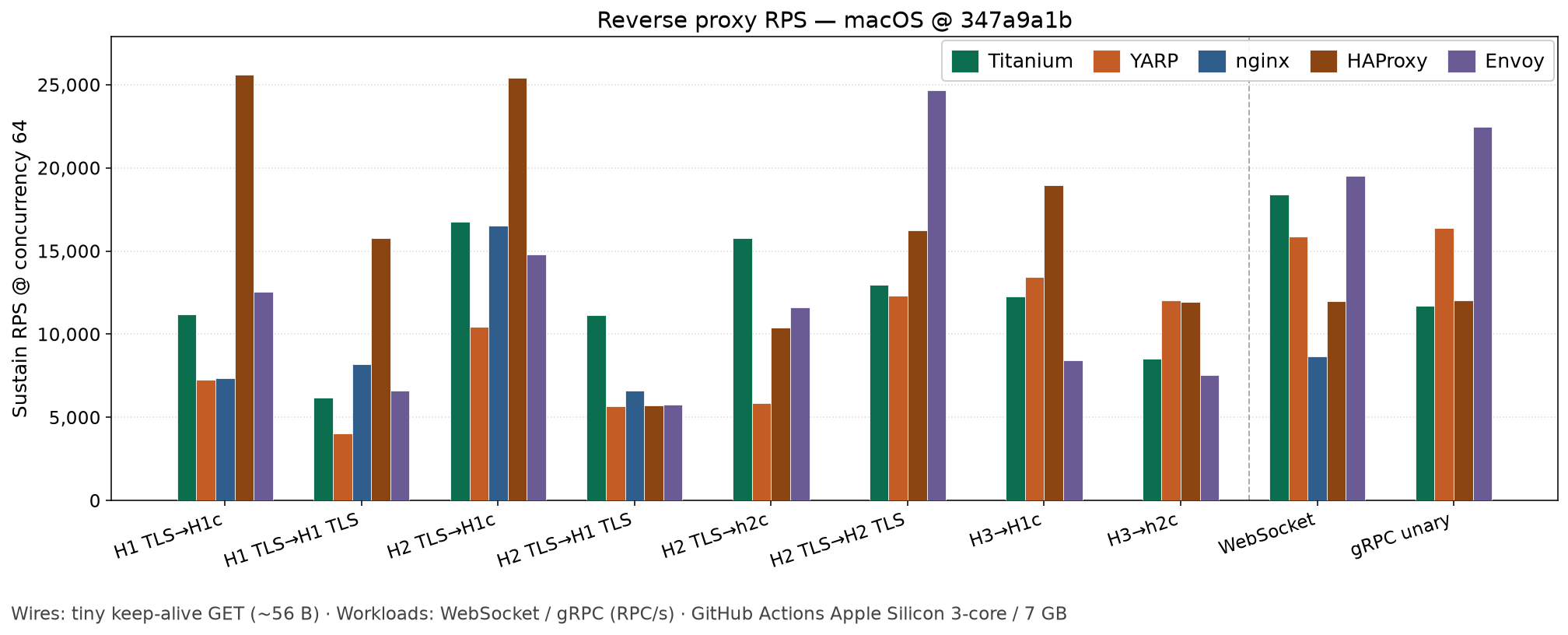
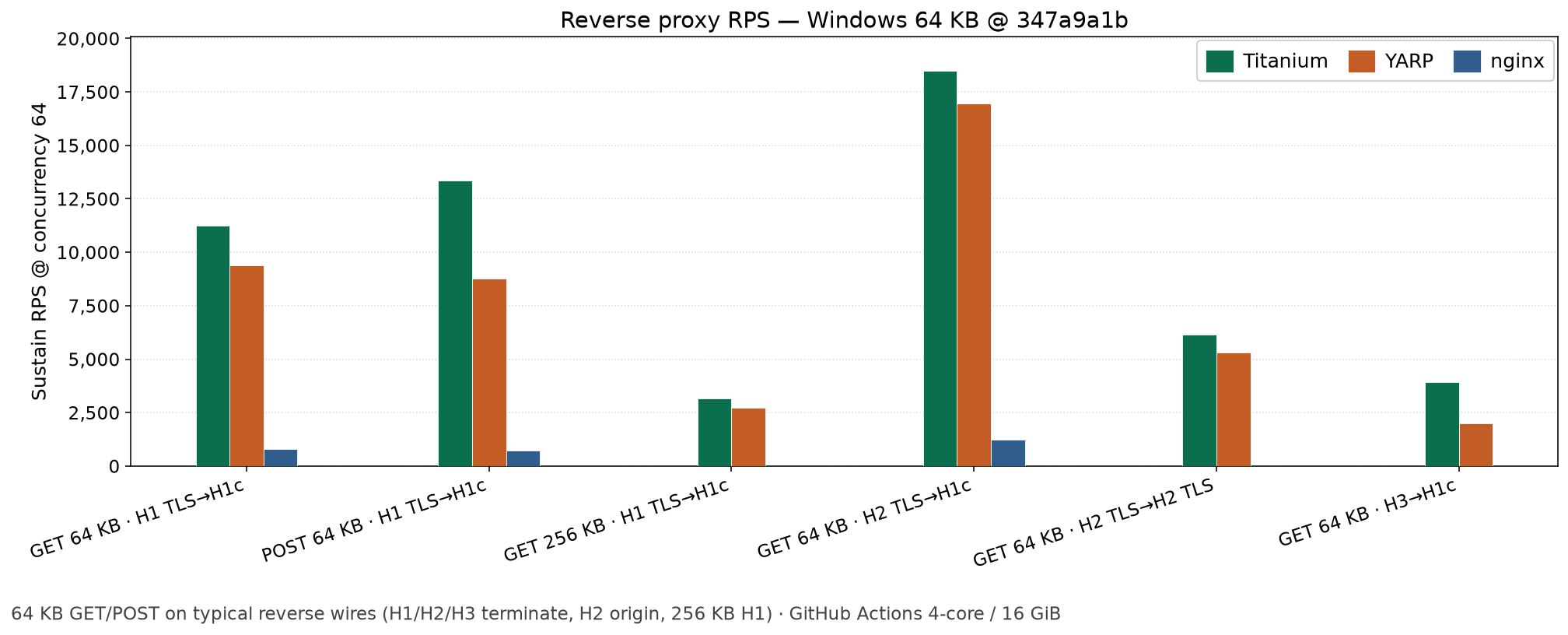
RPS is requests per second. gRPC bars are RPC/s (unary calls). Read within a chart (same OS), not Windows vs Linux as one number. Missing bars mean that peer cannot run that wire on that OS.
Practical reverse RPS (tiny requests)
Common reverse wires with tiny keep-alive GET (~56 B), plus WebSocket and unary gRPC — one chart per OS. How to read medals and workload shape: Performance wiki.
Windows
Linux
macOS
Practical reverse RPS (64 KB)
Typical reverse wires with 64 KB GET/POST (plus 256 KB H1 terminate) — body work separate from the tiny-GET chart above.
Windows
Linux
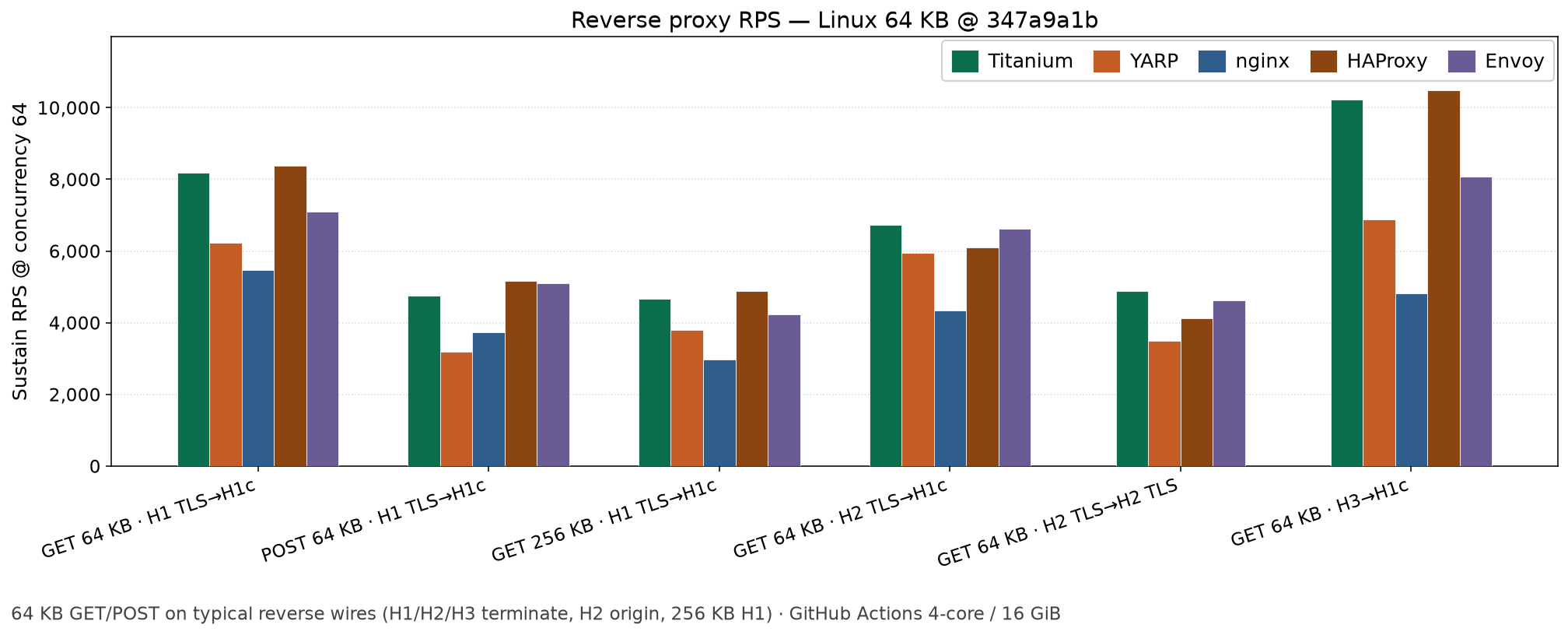
macOS
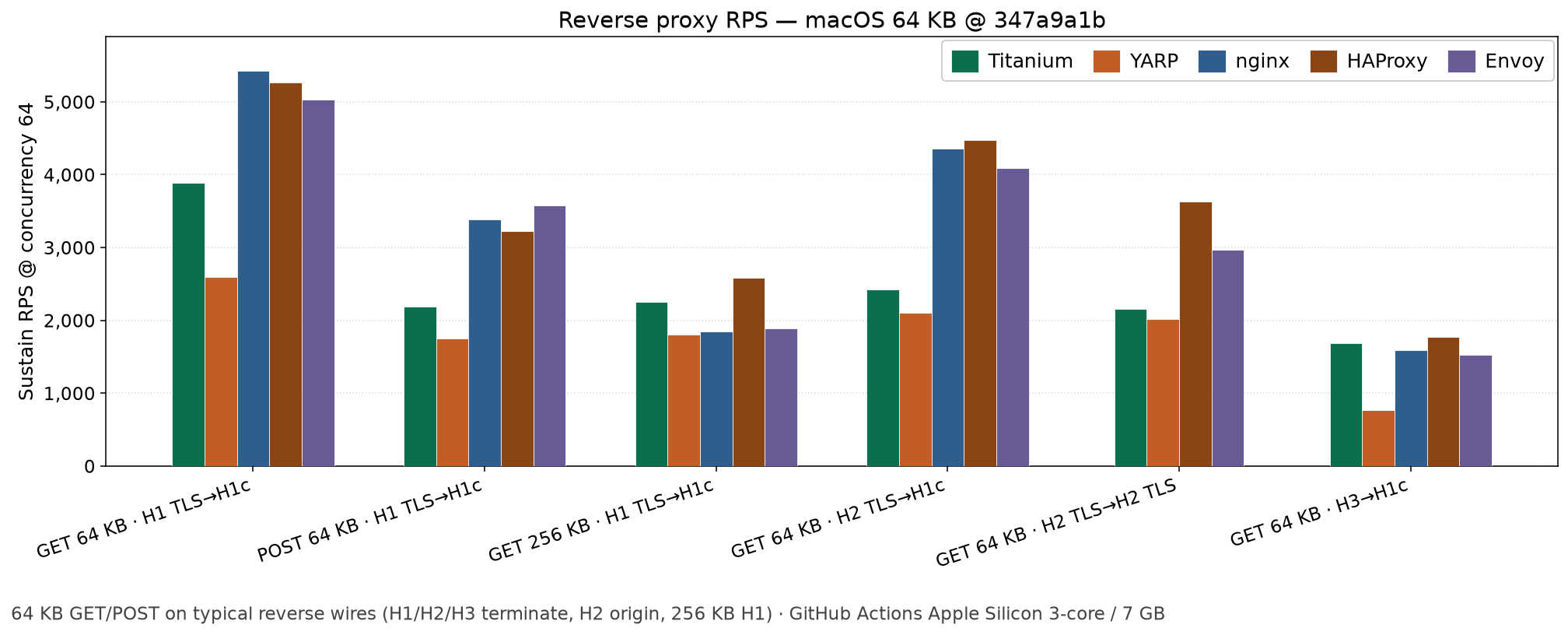
Heavier reverse workloads
Larger bodies, POST, lossy links, TLS termination cost, and architecture-sensitive shapes (slow consumers, duplex, WebSocket H1 Upgrade). Full tables are on the Performance wiki.
Additional real-world tables (wiki only, not plotted here): Unary gRPC H2→h2c, WebSocket H1 TLS→H1 TLS, WebSocket RFC 8441.
Full measurements
Product 5×5 reverse/MITM matrices, saturation calibration, heavier reverse (bodies/POST/lossy/TLS/arch), unary gRPC (H2↔H2 and H2→h2c), and WebSocket (H1 Upgrade, dual-TLS H1, RFC 8441 H2) tables live on the Performance wiki. Profiling notes: Performance profiling.
Relay validation and throughput
The default ProxyProfile.Balanced keeps PolicyFamily.Http2RelayValidation = Disabled, so H2↔H2 compressed relay forwards HPACK blocks without a semantic decode pass. Switching to PublicFacing (or setting Enforce yourself) adds a full HPACK decode on that path — re-measure with your RPS load probe after enabling if relay throughput matters for your workload.
How we measure: GitHub Actions runners — Windows / Linux at ~4 vCPU / 16 GiB, macOS at macos-15 Apple Silicon (3-core / 7 GB). Products are compared within an OS, not across OSes. Titanium vs YARP, nginx, HAProxy, and Envoy; same client, origin, warmup, duration, and concurrency (sustain at 64). Absolute RPS varies slightly with runner noise.